Memories of Union Station
You can scroll the shelf using ← and → keys
You can scroll the shelf using ← and → keys
Granddad was a conductor for the Frisco Railroad passenger service during the 1950s and 60s. He was based in Union Station and conducted the route through Fort Scott, Kansas to Springfield, Missouri, and back to Kansas City every other day.
My family lived in Fort Scott and would occassionally ride the train up to Union Station, or if we were in the city, would stop by the station to meet and have dinner with Granddad.
Like most people, I was in awe of the Grand Hall — bustling with people, the chandeliers, the huge windows, the announcements of train arrivals and departures — it was all very exciting. Travelers would come streaming out of the arrivals doorway with their luggage or being followed by porters pushing baggage carts.
The crowd would eventually thin out and there would be Granddad, standing tall and straight in his conductor’s uniform, talking with a passenger or giving instructions to his crew for their next trip.
My brother and I woudl go running up to say “Hi!” and then off we would go to the Harvey House. Sometimes a small group of Granddad’s friends (railroad widows) would to dinner with us. The ladies talked to each other the entire meal, occassionally acknowledging our presence by saying, “isn’t that right” or “don’t you agree?” Without waiting for a response they would continue talking. Granddad would pick up all the bills, leave a tip, and off we’d go — the ladies still talking — oblivious to our departure.
Oh yes! The food was very good.
I also remember the shoe shine stand at the west end of the Grand Hall next to the mens’ room There were four or five shoe shine chairs in a row. I twas a very animated scene with all the chairs filled. I can still see the boot blacks smearing on shoe polish — and hear the whappity-whap of the buffing cloths. This might not seem like much of a memory, but the guys were good. They shined shoes with a style and flare that made them seem like artists.
I’m excited that the station is being refurbished and put to educational use. I’m sure I’ll go visit and be in awe once again of the ceiling, the chandeliers, the clock, and Science City. But for me there is one fixture that can never be replaced.
Goodbye Granddad.
Even though I was born and lived most of my life in Carrollton, Missouri, a town about 70 miles northeast of Kansas City, since it was on the main Santa Fe Railroad line from Chicago and the Wabash from St. Louis, the Union Station was an active part of my life. During the late 1920s when I was 5 and 6 years old, the Santa Fe Railroad had what they called weekend excursions, reduced round-trip fares to Kansas City.
My mother would take my older sister and me on these excursion trips to Kansas City to shop. We would catch the train in Carrollton about 5 a.m. and the trip would take about two hours. We would either have breakfast on the train or wait until we got to the Union Station and Fred Harvey’s. We would take a streetcar up to the 12th Street area where we would shop all day and return to the station to catch the return train about 5 pm.
I had several relatives in the city; Henry Lewis, a manager with the K.C. Power and Light Co. for 50 years; J.V. Lewis, Kansas City park commissioner for over 25 years; and l.E. Miller, who was in the tax department under the Pendergast administration. In the early 1930s I would take the train by myself to make visits for 2 weeks or so. They would meet me at the station. Had my aunt not been able to meet me on the day I was slated to arrive, I would have been at the station during the Kansas City massacre in 1933. I arrived the next morning instead.
Pearl Harbor, December 7, 1941, took place during my high school senior year and I graduated the next May, 1942. I came to the city to live with my uncle, Henry Lewis, in the country club area on 68th Street. I attended a welding school at the North Kansas City High School with the hopes of getting a job in the war effort. Two weeks before I graduated, the 18-year-old-draft law was passed and no one would hire me with just school experience.
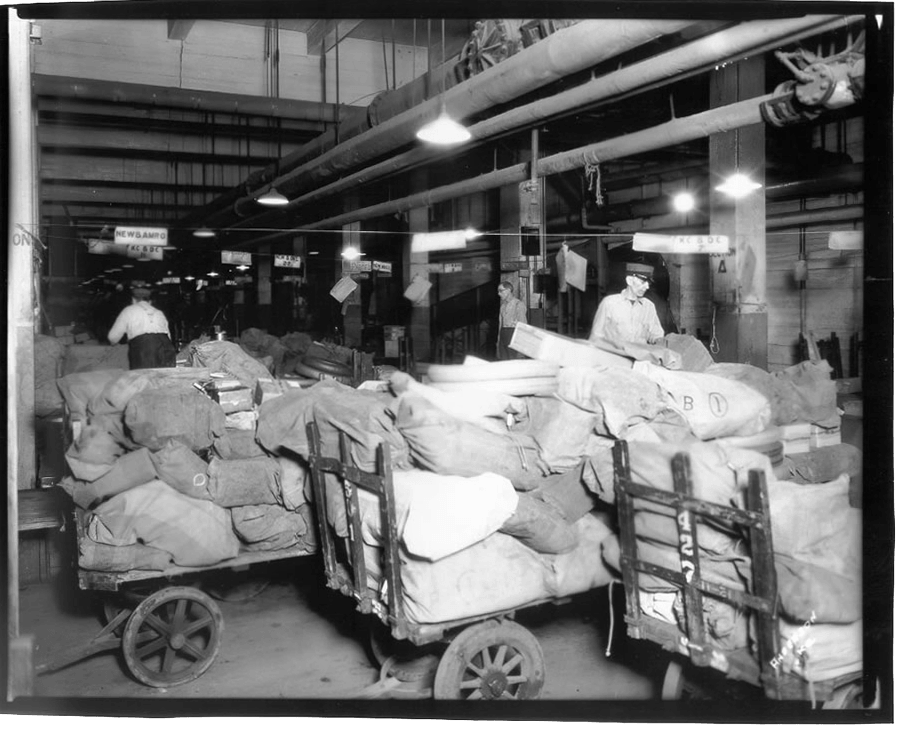
I went to work for Union Station’s railway mail and bagage department, where we worked on the track-level loading and unloading rail cars, and in the basement area of the station sorting parcel post from the post office. My shift we 3:50 p m until midnight.
I would take the country club streetcar to and from the station. After midnight they only ran owl-cars, one an hour. If you missed the one you waited another hour. I worked during the first full war Christmas mail rush. Through mail was so back logged that we had a pile of parcel post in the lower basement of the station over 50 yards long, 40 feet wide, and 6 feet high.
We would unload a car full on one end and take a load off the other end and send it out and on its way. We worked much overtime and were given time off to eat at the Fred Harvey station employee restaurant which was on the back side of the public restaurant at the north end of the waiting room. | worked at the station from September 1942 until April 1943 when I was drafted into the Army.
After basic training at Salina, Kansas I was asigned to an M.P.E.G. Company at Nevada, Missouri. We had Italian prisoners of war there, and we made trips overseas to bring back German P.O.W.’s All trips home or to other bases of course was through the Union Station. As the war in Europe was coming to an end I was reasigned to the Kansas City military police detachment. We were stationed at the Midwest Hotel just north of the Hereford House restaurant at 49th and Main. we had the entire hotel and I was assigned a room on third floor front whiqh contained two army bunk beds. We were required to sign in or out when when we came or left the hotel.
When I arrived they asked me where I worked before the Army and when I said the Union Station they told me I would be assigned as desk sergeant there immediately. Of course I already knew the tracks, most of schedules, how to find and read the information machines, and the overall parts of the station.
Our office was the small alcove at the southwest corner of the main lobby by the then-jewelry store. We had a desk, a lock-up closet, and a boarded up elevator for a lock-up or holding room. We also had a single outside door which gave us private access to our office.
We had three 8-hour shifts around the clock at the station with 3 to 5 men to a shift. When we signed out of the hotel we would walk over the viaduct to and from the station. Our primary duties were to assist all military personel through the station, but we also were to patrol the station, keep order, and assist the civilian police who were always on duty.
We had a red light on the top of the ticket office which I could switch on at my desk when I needed my men. I also inspected all M.P. Teams which rode all “in and out” passenser trains both from our detachment and others.
They would check their sidearms in when they signed in, which I would hold in the lock-up closet until they were ready to go out. Fred Harvey had a large room on the track level under the main restaurant area where they could sit and feed up to 250 men at a time. We were informed of all troop movements, number of men, trains, and arrival times. My men and l would meet those trains, escort the men to the restaurant and return them back to their trains.
I was desk sergeant at the station from late 1944 or early 1945 until I was discharged from the Army in April 1946. During my long assignment I made many friends among all who worked at the station. I am only sorry that I cannot remember their names: the redcaps who helped us in so many ways, the civilian police who we worked with. On the day shifts we ate downstairs in the troop room where we knew all the Harvey girls. I remember vividly the birthday party they had for me on my 21st birthday, with cake, decorations, and appropriate signs such as “first legal beer”. At night, when that room was closed, we ate at the main restaurant on the east end of the lobby next to the west port room, and knew the personel there.
During the day, the station was always crowded and busy, but at night, in the wee hours of the morning, things quieted down. The Union Station floors were mopped every night until they sparkled.
I remember a large heavy-set black man who used a mop with a 4 foot mop-head. He mopped with an easy large figure-eight stroke. On his night off it took three men to do the same amount of work.
I was on duty at the station on both V.E. Day and V.J. Day. Though V.E. Day was met with some exuberance the station remained relatively quiet. V.J. Night was something else. Since we knew it was coming for several days we were on alert and told not to be over 30 minutes away from our post and to report immediately.
The station filled up to wall to wall. Never was I kissed and hugged by so many strangers. The celebration continued for the whole night. The next day there were long lines extending way out into the lobby waiting to get into Fred Harveys. Most everything in the city was shut down and hundreds were unable to get food, even milk for their babies.
After my college years in California, I was in the station often to meet my future wife who worked at the BMA buikding across the street from the station. We would meet under the clock and take the train home to Carrollton. As the years went by there was fewer and fewer trains, and finally trains no longer stopped at Carrollton.
[In 1994] when you held your first open house, my son-in-law who had heard many of my stories, was anxious for us to attend. He wanted me to see if my key, which I still had, would open the track gates. We drove up, visited the station with all the others, and sure enough the key still worked the old locks. Some few had new locks. The building’s condition was depressing to me but I am pleased that you are making progress in restoring my part-tlme home. I joined the “Friends of the Union Station” and I wear my pin with pride. I sincerely wish you success with your plans and hope you can fulfill them in my lifetime.
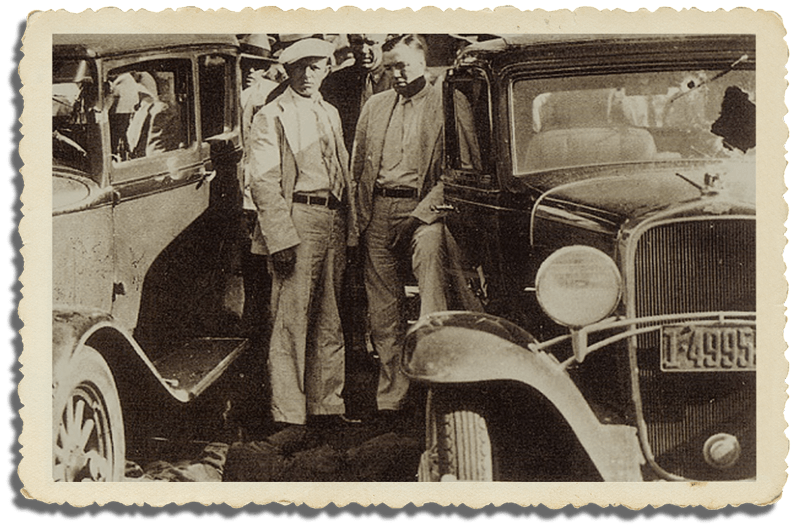
In the year 1933 a horrible event occurred just outside the station.
I had been working a night shift at a dairy at 25th and Washington streets. A dangerous outlaw named Frank Nash was to arrive at the station to be transferred to another prison. This was an important news event and several detectives and police were present.
As I walked east past the station I observed an old Ford car in the parking lot. Two men were in the front seat. The car carrying Nash was parked near the station door. At the time I was not aware of what was in the making.
I was making my way to Main Street to catch a street car home.
I was not completely past the building when the machine gun fire split the morning air. Well I ran as fast as I could to the waiting street car.
Later that day I learned that Floyd and Richetta gangsters had killed five men. One was Mr. Nash.
The bullet holes can still be seen in the granite walls about where my head had been moments earlier. Close call right?
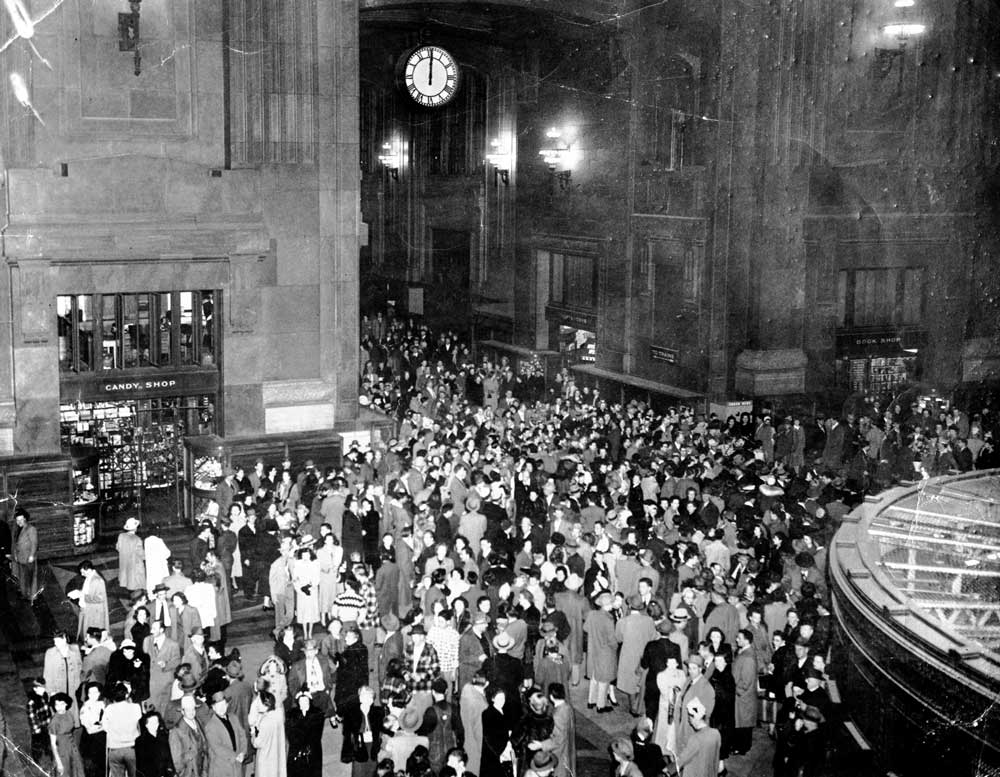
As a child I will always remember the thrill of going to the station when we had relatives coming to town. We would stand breathlessly in the cavernous lobby peering anxiously down the long “arrival” corridor to perhaps get a first glimpse of our guests. Once in a while (if you had an agreeable doorman,) he would let us run down to meet them or when seeing them off you could go down to the track level to wave goodbye. The massive engines, puffing their streams of steam or purring diesels made conversation sometimes difficult.
We have close association with the Kansas City Terminal Railway for whom my father-in-law worked all of his life as an electrician, repairing the air conditioned cars, coaches and streamliners that once pulled into Kansas City, the only “in and out” station in the nation (meaning the trains did not have to be backed out of the station in order to continue their journey) as was the case in most others.
Of course we had the wonderful roundhouse which was a marvel to see the engines loaded on the turntable and then the repairmen could get in the pit and oil, grease or repair them. My husband was a locomotive fireman and engineer for over twenty years on the terminal. When our children were small we even took the chance of letting them be in the “cab” and pulling the whistle as the engine was driven around the loop. One didn’t realize what a hulk of power and machinery was at man’s disposal until you had an engine towering above you.
I remember my first New Years Eve “under the clock.” I don’t remember what year it was, probably i943 or 1944. World War II was still in progress. We were a bunch of high school kids, not yet involved in the war except for bond stamps, sugar, shoe and gasoline rationing.
I didn’t have a car. My folks did, but I wasnt allowed to drive yet. One of the fellas in our group had a party and his Dad volunteered to drive the “bunch” (about 6 couples in our group) down to the station. In order to try and keep from getting separated, we all tied long strings to our wrists with big green balloons tied on to them (this was our school color).
It was a good thing we had agreed on our meeting place to go home by 1 a.m. because when we got to the station all ballooned up, there were balloons everywhere, tied to vendor booths, in the Harvey Restaurant, and decorating the balcony that encircled the main lobby.
“Under the clock in Kansas City” was like Times Square in New York. Everyone hugged one another, stranger or not and wishes for a New Year bounced from everyone’s mouth. When the final tone of midnight struck, it was like the 4th of July with many of the balloons bursting with the prick of a bin. Hot chocolate from the Harvey House brought us together and just in time, for our ride was at the Southwest entrance near the baggage handling department.
Before we became parents when my husband worked at the terminal, sometimes I would meet him in the station on his supper break for a leisurely stroll to peruse the shops or pick him up at the locker room for employees west of the station among the maze of tracks. I waited in the car but it always amazed me how the engines came and went, criss-crossing the “yard.” Now its all computer controlled for the most part and the roundhouse has succumbed with the demise of the voluminous passenger business which is no more.
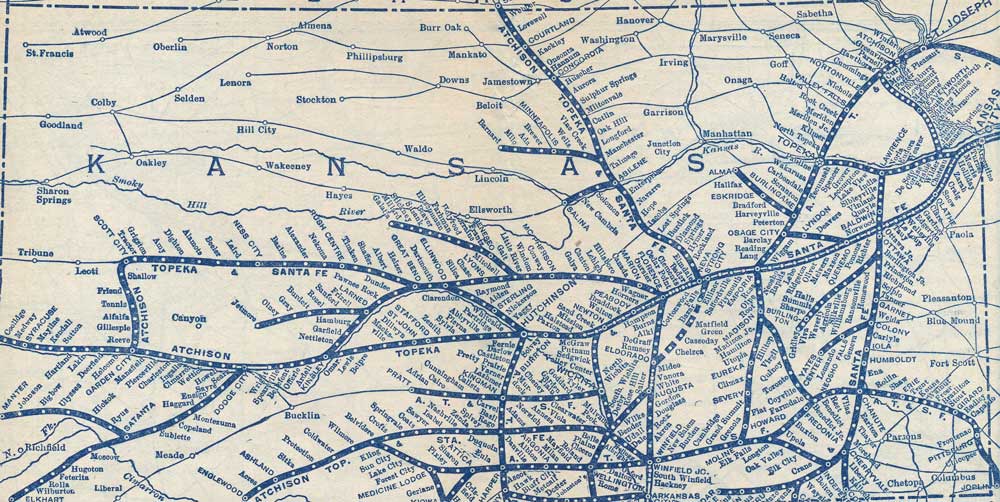
My memories of the Union Station go back about 65 years as the daughter of a Santa Fe conductor on the Middle Division. We had “pass” privileges and when Santa Claus visited for the Thanksgiving parade, we made annual pilgrimage from Emporia, Kansas.
There are sensory memories. The Union Station had its own odor. No doubt the steam engines contributed to this. There also was a low grade hum. Not loud, not interferring, just constantly there, irrespective of the hour.
In the middle of the entry area at the South end of the Station was a circular type counter for the ticket agents and information. Other businesses spun off in this general area. On the east side was the Harvey House with its white linen draped tables welcoming the visitors through the sparkling glass windows.
The adjacent women’s restroom was huge. As I recall, a traveler could shower, and a trip on a coal-fueled train with the open windows in the summer must have made a long distance traveler welome a bath.
I haven’t the remotest idea what or where the men’s restroom was. There were several little stores in the lobby area. One was a jewelry store, another a gift shop, and a snack shop exuding the odor of fresh coffee into the atmosphere. Some place sold big sugar-coated cake doughnuts. Boy, were they good!
There were many Red Caps, independent entrepreneurs, I think. They assisted passengers to and from the trains. That was a long time before one could roll a suitcase around. You boarded the trains through gates on either side of the waiting area. On either side of the gates were back-to-back highly polished wooden benches. For the really tired, they just laid down and took a nap. When your train was “called,” you walked downstairs seemingly forever to your train’s car.
It was particularly cold in the winter. You exited trains into the lobby opposite the front doors. Time passed. The wag jammed the station with every military uniform enroute to or from leave. And, of course, many trains passed through packed with military and never spent time in the station’s lobby or waiting room. But the Red Cross ladies did visit them, and passed out home-made sweets.
It goes without saying that all railroads passing through Kansas City, passed through Union Station, which is unlike a good many cities. Many of my relatives were Santa Fe railroaders, either on the trains, or in the offices. I’m sure they would be shocked at the change in railroading as it is today, but I’m certain they would be proud and approve the beautiful station and its renewed purpose.
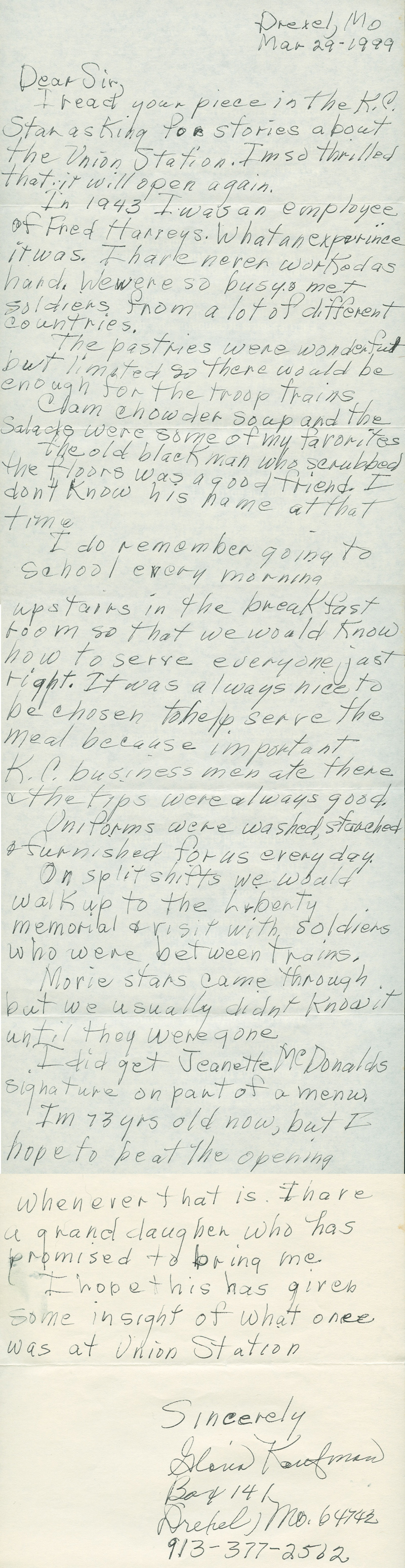
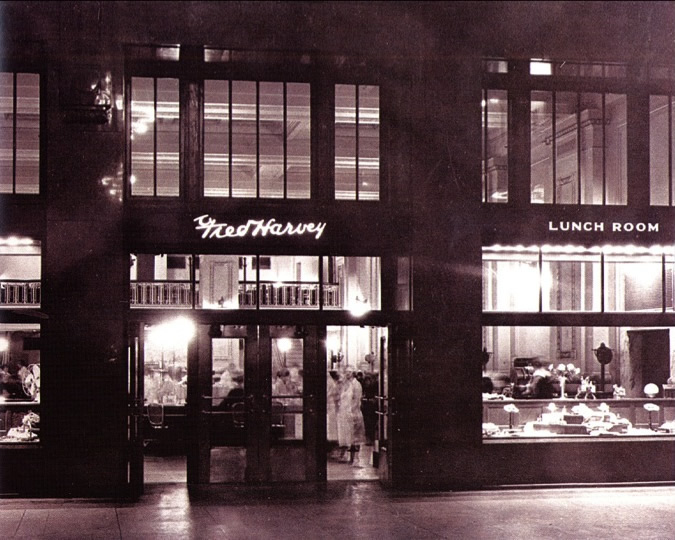
Back in the 1950s, my friends and I would go down to the Union Station to wander around through the shops, watch the people coming in from the trains and eat lunch. Since we were black, we could not eat at Fred Harvey’s.
We ate way in the very back of the station at the lunch counter with the stools where the railway employees ate.
In the 1960s when the Public Accommodation Law was passed, we started eating at Fred Harvey’s. All of the waitresses in all of the Fred Harvey’s throughout the country were middle aged white women. Most of them were skilled enough at their jobs to graciously take in stride having to wait on Negroes (that’s what we were called then).
I recall one waitress who brought me a little silver gravy boat of gravy when I asked for extra gravy for my hot beef sandwich. I tipped her generously.
But on one or two of the waitresses simply could not conceal their dislike and resentment at having to serve us. I never reacted to their discourtesy. I pretended not to be aware. But when I departed, I gave vent to my true feelings. I left a penny tip on the table!
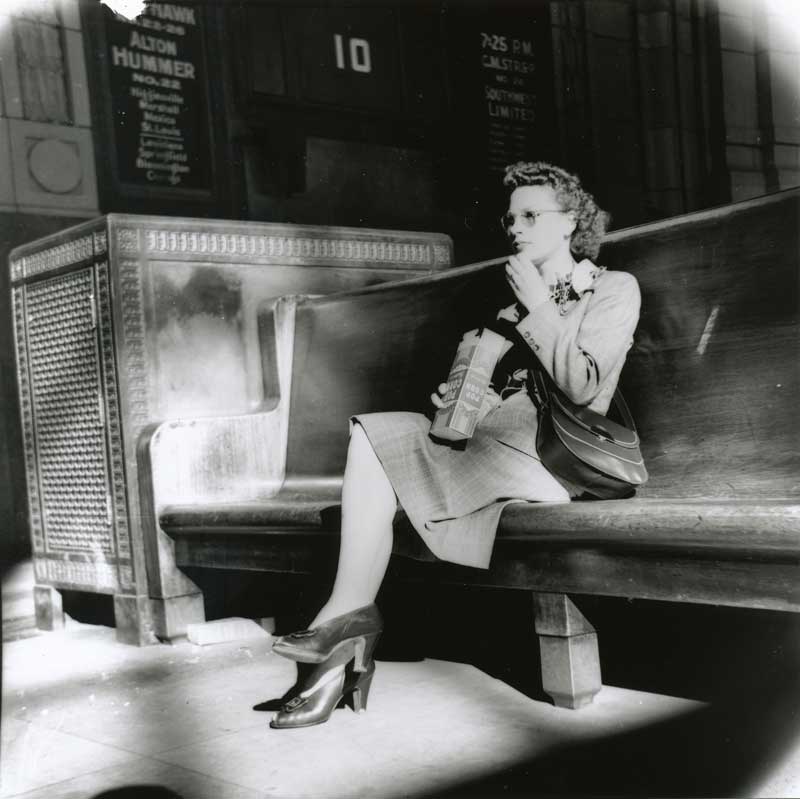
My mother, Bernice Rick, sits in the North waiting room of Union Station on May 25, 1947. This photo was taken by my father Robert Rick with their first new (Argo Flex) camera. If you look over her right shoulder you can see some of the trains listed that used Gate #10. They met at a USO dance while Dad was stationed at Scottfield near St. Louis.
Mom grew up on a farm near the airfield in Illinois. Dad was a native of Kansas City. They married in 1944 and came back to K.C. after Dad was discharged in 1946. Dad worked his first job after the war at Union Station (1946-48) for Western Weighing Bureau on the third floor. He later went to work for Union Pacific, in the Central West Bottoms, but missed the hustle and bustle of Union Station.
Mom and Dad both enjoyed going to the station for their enjoyment. One of these many outings were captured by their new camera. Mom also would use Union Station for her trips back to visit her family in Illinois. When my brother and I came along, we would accompany her on these trips on my Dad’s rail passes.
I still remember all of us hurrying along the platform beside our train — which seemed a mile long — as the conductor’s song, “All Aboard” rang out!
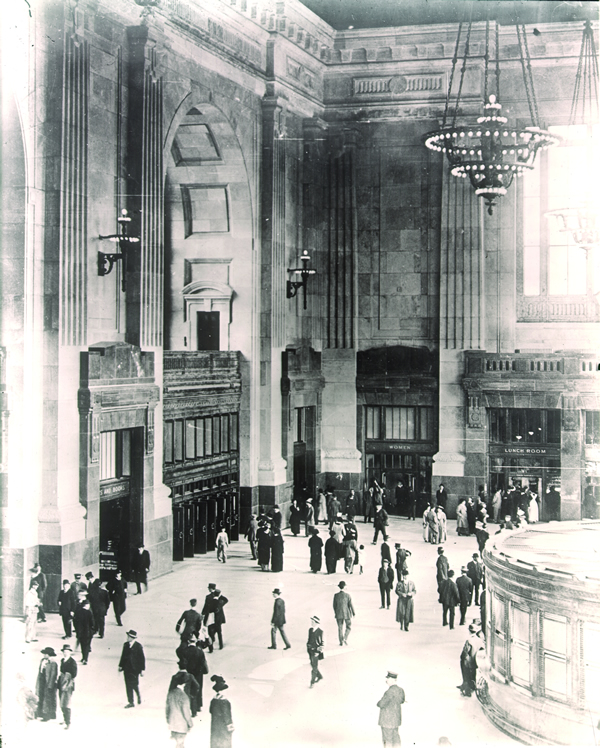
It was February 1920 when my mother died in Corbin, Kansas, of the terrible flue epidemic. I was the oldest of four children at 9 years of age. My Dad was unable to care for us. The baby, only two, was soon taken by an aunt and uncle to live in Missouri. The remaining three of us went to Purcell, Oklahoma, to live with Grandma Lawson. About a year later Dad brought us back to Corbin for a few months. By the summer time Dad decided that we should go to Pleasant Hill, MO. I was to go to Uncle George Longacre’s and my brother, Thurman, and sister, Mildred to Uncle Fred Brown’s.
Dad took the three of us to Wellington, Kansas where the four of us caught the train to Kansas City. All my life I had lived in very small fanning communities. Coming into Union Station was entering a shocking, different world.
I still remember the great, big doors, the very tall, tall ceilings, and lots of people. I had never seen so many people … enormous numbers of people. And all that huge large hall was filled with a blue cloud of cigar smoke.
The whole thing was so big, I could hardly believe it. I remember the ceiling has lots of fancy decoration on it.
At Uncle George’s, I attended my fifth year of school. But since there was no fifth grade, I was placed in the sixth grade. I did terribly! By the next summer it was decided that my brother and I would go to Wellington, KS, to live with the Blazier family, friends of my dad. Grandpa Lawson had died by this time and Grandma had moved back to a tiny house in Strausburg, Missouri. Mildred stayed with her.
Uncle Ivan Longacre brought us to Kansas City to catch the train back to Wellington. I remember going down a long flight of stairs to get to the train. We looked for a certain gate with a specific number on it. We were told to go to the front of the line so that we would get on the right train, which was very important because some of the cars would be switched off and go to a different destination. At that gate there was a man in a uniform with a big watch. At the specified time, he would open the gate and people flooded onto the train. Our uncle helped us get on the train.
We had also been told of how important the porter was. We kind of considered the porter as the living part of the train. It was the porter’s business to help you with your luggage. We were carrying a small suitcase. The porter would make sure you got into the right seat. Porters were very helpful. Because of that, some relative had given us a special coin that we were to give to the porter. From Kansas City the train went to Topeka where it went passed the station, men backed into the station on a separate track. The coach was then switched to a different engine to go south to Oklahoma. We hoped we were on the right part of the train.
On this second trip through Union Station, we looked out a window or the front door and saw the big tall tower in the process of construction. Someone explained to me that it was a war memorial. I didn’t understand what that meant.
Many years later I visited Union Station when it housed an antique car show. We stayed long enough to have dinner at the restaurant there.
I have so many memories of Union Station it’s hard to single one out. My father worked for ti-ie kansas city terminal from 1926 to 1965, as a redcap, assistant station master and on the public address system.
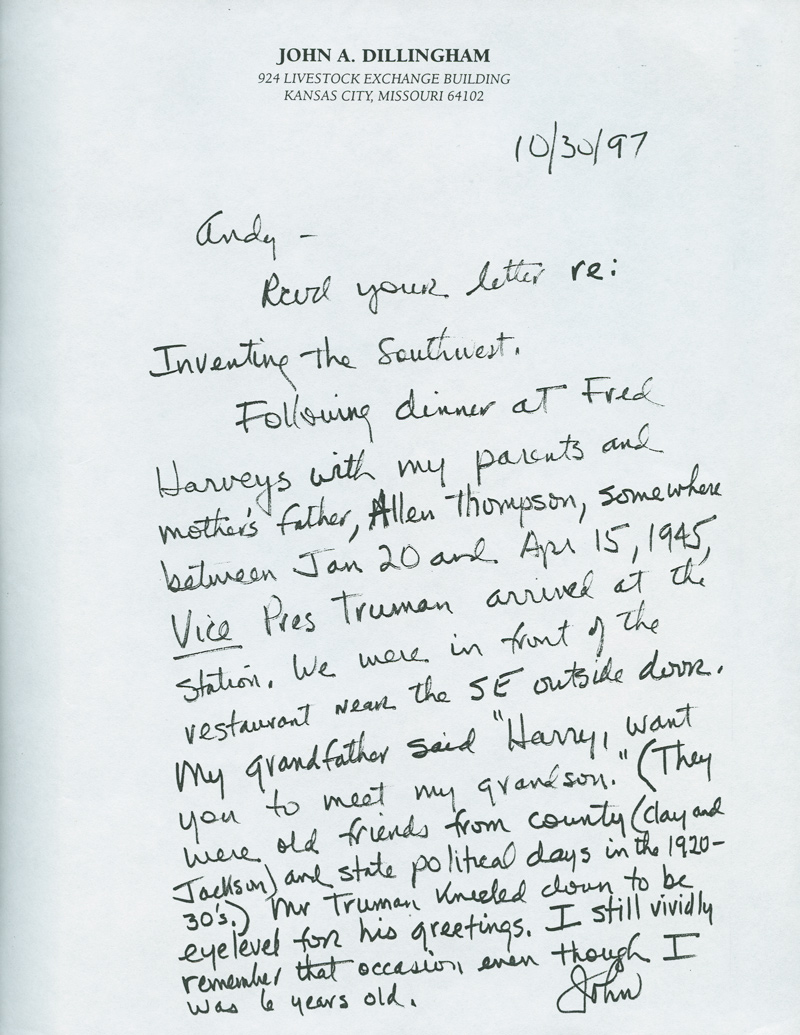
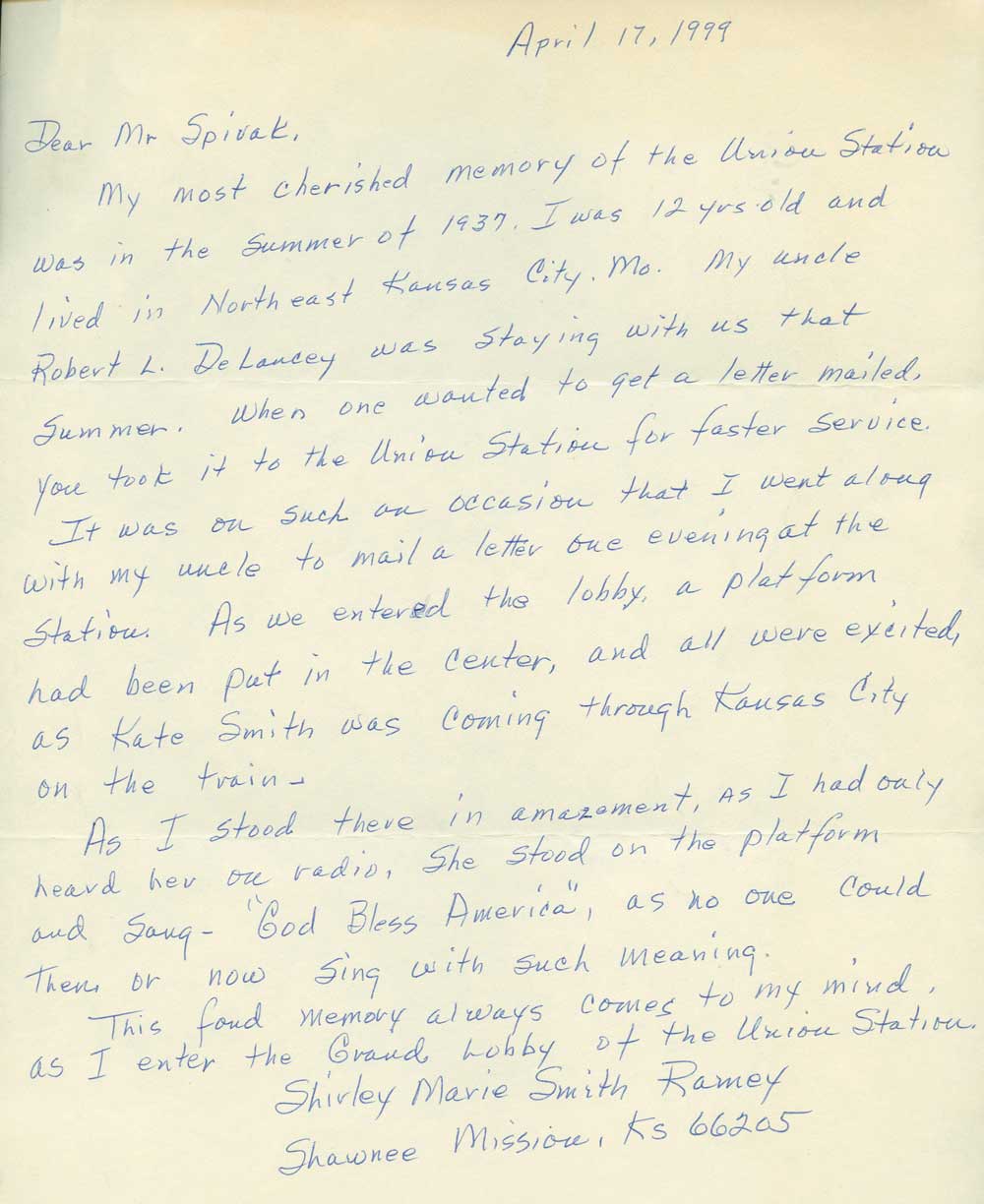
I loved to go to work with him. He worked 3 p.m. to 12 a.m. We would have dinner in the employees’ lunch room way in the back of the station. All the redcaps would be talking about the famous people they may have helped that night. I saw several myself. Roy Rogers, Burt Lancaster, and Constance Bennet. I saw Kate Smith sing for the troops during World War II.
I passed my evenings by reading comics and movie magazines borrowed from the stands that were in the middle of the lobby, also there was the Fred Harvey toy store full of toys unique to that store.
There was also a soda fountain with all kinds of sundries needed for travel. We would have ice cream sodas at the fountain. The ladies restroom was a huge waiting room with couches for naps and rocking chairs for calming tired children between train connections. Sometimes we would exchange addresses for pen pals.
One night, my dad came home with a large box for me. He said Cecil B. DeMille bought it for me.
I couldn’t believe it. It was the beautiful baby doll I had been wanting for weeks at the Fred Harvey toy shop.
My dad had carried Mr. DeMille’s luggage and had been tipped $50. My dad used it to buy the doll. I told everyone Mr. DeMille bought it for me. It was my favorite for years.
During World War II I lived with my family in a small town in Poland. In December 1939 I was captured by the Nazis and found myself in many concentration camps for five years.
I was liberated by the British Armed Forces in May 1945, spent three months in a army field hospital since I had typhus and starved … almost gone.
After my release from the hospital in Soltau Germany, I spent a year in a displaced persons camp where I met my future wife and found out that my whole family was murdered by the Nazis.
December 1945 President Truman spoke to the nation and said that he will ask Congress to let a 100,000 refugees come to the United States. We decided if this happened, we will be there.
In June 1946 we were on the Marine Perch ship, going to America, along with my wife-to-be Ann Warszawski, her sister Gusti, her brother Aron Jack Mandelbaum, his uncle Zigmund Mandelbaum, his two cousins Bob and Arek Mandelbaum, Geniek Mittleman and David Wolowski — all Holocouast survivors.
Thanks to President Harry Truman, the Joint Distribution Committee (J.D.C.), the Hebrew Immigrant Aid Society (H.I.A.S) and the K.C. Jewish Federation who made all this possible.
After three days in New York City, H.I.A.S told us that Kansas City is where we should go to live.
They gave us $50, on the train we go, after a transfer in Chicago, we arrived in Kansas City Friday morning at the Union Station.
We knew no one, we spoke no English; however, we noticed a young lady that tried to speak to us, her name was Esther Cohen/Levens. She worked as a volunteer for the Jewish Family Service. She kind of took charge.
We will never forget that friday morning at K.C Union Station. We have been here since Ann and I married, raised three wonderful children, all married. They gave us five wonderful grandchildren.
We love our wonderful family, we love America and we love Kansas City.
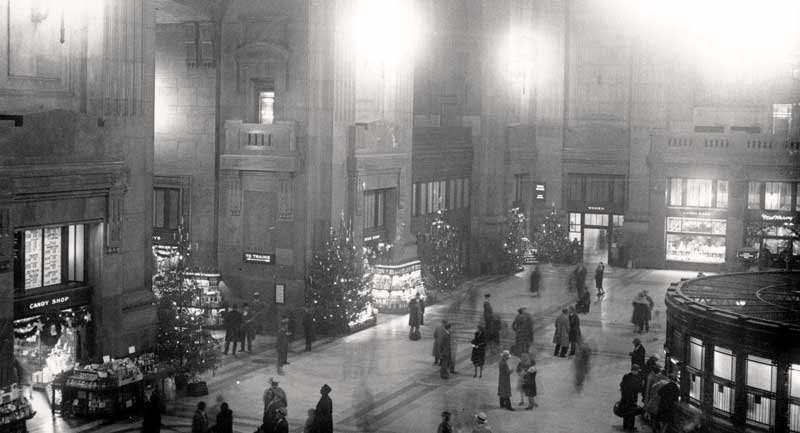
One of many memories of the Union Station occurred in the early 1930s.
I was a student at Southwest High School and sang with the a capella choir.
During each Christmas season, all the high schools in the area would gather at the station to sing Christmas carols.
The choirs were assigned separate alcoves in the balcony. These positions overlooked the throng of people buying tickets or arriving through doors “A” or “B.”
Each choir, in turn would sing a different carol. The sound echoing throughout that vast building was nothing short of breathtaking!
On the roof over the ticket sales structure, a beautifully-decorated Christmas tree greeted one and all. In front of the tree stood a microphone waiting for the director chose from one of the schools. For the finale he would lead all the choirs and those in the audience in singing “Silent Night.”
Needless to say, the Christmas Spirit was greatly enriched for all those in attendance.
In the summer of 1942 just after graduating from from Westport High School, and before going into service, I was a red cap at the Union Station.
We worked for the K.C. Railway Company and were guaranteed 45¢ an hour. We were issued 50 bag tags at 3:30 p.m. Each bag was tagged for 10¢. If we carried 45 bags that evening we would turn in $4.50 to the cashier. We were paid twice a month. That amount was our minimum, but we made much more in tips.
I remember one night a lieutenant from Fort Riley had me carry his bags. They were so heavy I could hardly lift them. He finally told me they were full of booze (whiskey) for friends at the camp.
Speaking of heavy bags, we learned to avoid salesmen with big black sample bags!
During the time I was employed at Union Station there were no elevators for passengers, so we had to carry the people using wheelchairs up and down the stairs.
Those who had Pullman tickets were my favorite passengers to take to the train. These cars were air-conditioned, and felt so good in the summer heat.
Many people were on the move during the war. We saw troop trains, wives and families of servicemen, and entertainers … all interesting groups of people.
My day ended at midnight. Before heading home on the streetcar I would go to Fred Harvey’s and order cantaloupe topped with a big scoop of vanilla ice cream. My treat at the end of a busy day!
The words Union Station always stir up special memories for me. My father, Walter A. “Swede” Nelson, worked for 46 years for Western Weighing Inspection Bureau, whose offices were located on the second floor of the station. As a small child, I loved going through the bustling station and up the stairs to play at my fathers desk. Because Dad worked for a railway agency, we used passes to ride trains for most of our family vacations, to such places as Miami, San Diego, and Sun Valley, Idaho.
The wonderful train rides included picnic baskets, packed for the first day on the train, Dad checking on the trip at every stop (sometimes running to get back on the train on time), and the privileges of the dome car and the elegant dining car.
My sister has similar memories from a generation earlier (she is 16 years older). My last train rides to and from the station were to college in Illinois in the late l960s.
But my favorite memory involving our family’s long connection to the Union Station is really my parents story of their departure from the station for their honeymoon trip. My parents were married June 5, 1928. My mother, Pearl, was 17, and my father, Walter, at 21, had already worked for WWIB at the station for about two years.
Threatened with kidnapping and separation by the groom’s church friends and teenage brothers, the couple hid all night in a coal bin at the bride’s grandmother’s house before their train was to leave for Colorado on June 6th.
Knowing that the young pranksters were then waiting in the lobby of the Union Station, my father got help from friend Joe Wolfe, who managed the baggage department.
Joe met them at a side door of the station and took them to board their train by a back stairway.
That was Pearl and Walters first trip from the Union Station in a marriage that lasted 66 years, until his death in 1994 at age 88.
When I was very small, I thought that my father was a very important man at the Union Station. I still do.
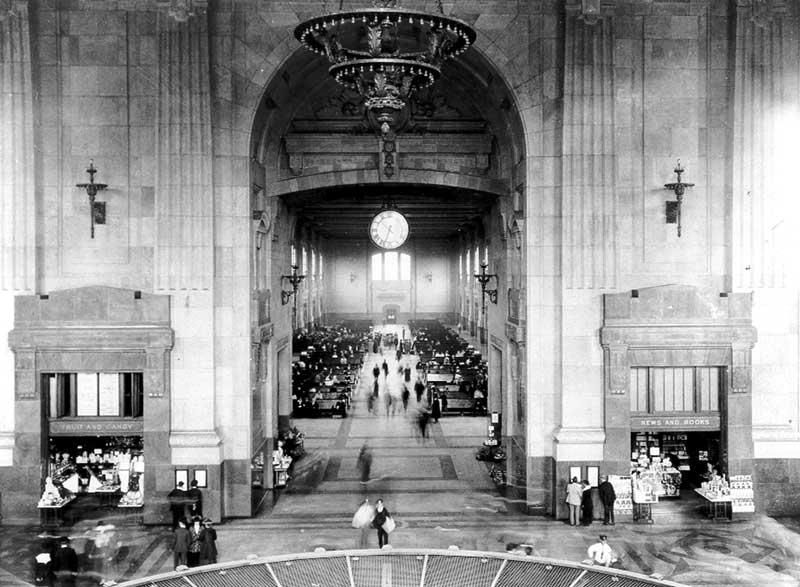
As a young girl living in Independence during the 1920s-30s, many of our out-of-town visitors would usually arrive by train, so it was an exciting time to meet aunts and cousins at the Union Station. What fun waiting near the big doors for them to arrive, to sit on the long wooden benches, listening to the announcements of trains arriving and leaving.
It was important to dress up in your sunday best when going to Kansas City, and what a special treat to have lunch at the Fred Harvey Restaurant there in the Union Station. It was a long walk from the huge waiting area to the restrooms; so when you are 13 or 14, quite grown up (you think), and at that age easily embarrassed, especially after a trip to the ladies room, to have a stranger say, “Pardon me Miss, but did you know that you have the morning paper on your heel” OH MY! was my face red, seeing that strip of toilet tissue stuck to the bottom of my shoe.
Aug. 1942, I left the Union Station aboard a train For Tacoma, Washington (a 3-day and 3-night journey) to visit my fiance, who was a sergeant in the Army, stationed at Ft. Lewis. On Sept 2, 1942, we were married im the chapel at Ft. Lewis. In just a few weeks, Alan received his orders for active duty to Hawaii, South Pacific area and Philippines Islands.
After three years, Uncle Sam finally released him to return home.
It was a very special reunion for us to meet again under the big clock at the Union Station about 2 a.m. that October morning in 1945.
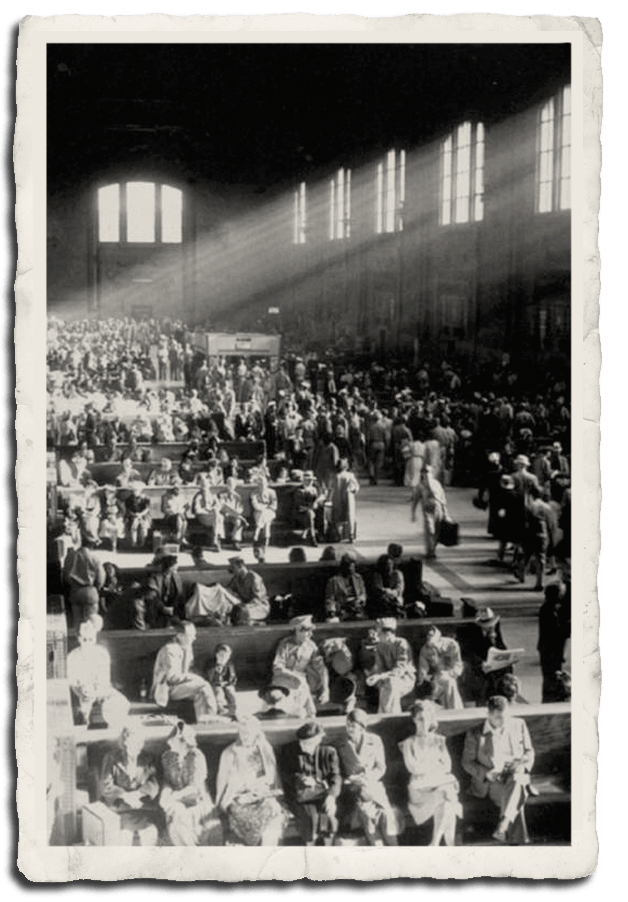
In the eyes of a child, everything is big. This was especially true of the Union Station. It seemed to be the biggest building in Kansas City. Sometimes I was allowed to wander around the stations cavemous interior within sight of my parents.
I would stop and stare up at the great chandeliers. I often thought, “Who is the person that dusts the chandeliers?”
It seemed to me it would be a dangerous job to be up so high dusting the chandeliers.
My wanderings always finished in the Waiting Room. I would sit there and watch the smartly-dressed travelers pass by, watch the minute hand move on the big clock, or hear an important sounding voice coming from a loudspeaker naming exotic places such as Chicago, Flagstaff or New Orleans and trains with equally exotic names like Super Chief, Portland Rose, or Southern Belle.
If it was wintertime and I was cold I would stand with my back next to one of the big steam radiators and be warm in no time. If was sleepy I could lay down on one of the big wooden benches and take a nap just like the soldiers and sailors.
The memory of seeing the servicemen and women in the Waiting Room recalls something my maternal grandfather always said whenever he was in a crowded, busy public place: “Yep … this is busier than Union Station during wartime!” I heard an estimated 4 million servicemen and women passed through Union Station during World War II. The Waiting Room was probably pretty busy.
I am glad to see Union Station restored. I will be interested to see if the Waiting Room is still as big as I remember. Who knows, I might also actually see someone dusting the chandeliers.
Bill started his 36 year employment at Union Station on February 13, 1942. Previously he had worked at the Jones Store in downtown Kansas City where he met Jerry Burke, a local travel agent with an office in the store. Bill often made deliveries for Jerry in his free time. One day, Jerry told Bill about an opening at Union Station for a job in the ticket office. Bill interviewed with J.W. Dunn and took the job!
After three days of training — no pay! — he began as a telephone clerk before moving to the job of ticket agent, often working the night shift and with only one day off each week. Ticket agents were responsible for calculating train fares, based on mileage. There were several fare types … standard, clergy, first class, “remains” unescorted, “remains” escorted, and round trip. Tickets had to be purchased in cash … no checks!
There was a strict dress code … white shirt and tie. On May 15, 1942 Bill’s son Bill, Jr. was born at nearby St. Mary’s hospital. Dad showed up at work in a blue shirt and was sent to a local shop to purchase a WHITE shirt!
During the years of very busy train travel, agents frequently had to work overtime and needed a place to rest before their next shift. On the 6th floor of the station was a dormitory operated by Pullman Conductors.
One advantage of working at the station was the availability of good food at the Harvey House. In the early years the ticket sellers had their own table and the average cost for lunch was 75 cents! Bill was a friend of Joe Maciel “maître d” at The Westport Room and secured the recipes for two favorites …”Picatta” and “Chicken Maciel.” They remain family favorites.
Bill worked the station from the peak of rail travel during World War II, to its decline in the early days of Amtrak. He knew President Truman, celebrated New Year’s on the top of the circular ticket office, raised a fine family and traveled — by train — throughout the United States.
After 36 years at the Station, he retired at 8:00 AM, September 6, 1978, after completing the night shift.
At the time of this writing, October 6, 2014, Bill just had his 96th birthday and plans to attend the celebration on October 31.
I have very fond happy memories of “the Station” that date back fifty years.
In the 60’s my mother worked at Union Station as a teletype operator for the Rock Island Railroad and sometimes, if we were well behaved and presentable, my Dad would pack my four sisters and me in the station wagon and let us go with him to pick her up.
It was a thrill for us to go into this big magnificent building with all the hustle and bustling going on.
We got to sit and slide across the benches that lines the Grand Hall. We were in awe at the height of the ceiling.
We visited with the shoe shine man.
And, best of all, we got to ride the elevator and there was an operator on it that worked a wheel in it to make it go up and down. Sometimes he’d let us spin it.
When we’d leave there, we always felt like we had just left a magical place.
Now, fifty years later, I volunteer at Union Station and I still feel like it is a magical place every time I enter it. It is sad it is not a booming train station like back in the “good ole days” but air transportation did passenger trains in.