Memories of Union Station
You can scroll the shelf using ← and → keys
You can scroll the shelf using ← and → keys
Granddad was a conductor for the Frisco Railroad passenger service during the 1950s and 60s. He was based in Union Station and conducted the route through Fort Scott, Kansas to Springfield, Missouri, and back to Kansas City every other day.
My family lived in Fort Scott and would occassionally ride the train up to Union Station, or if we were in the city, would stop by the station to meet and have dinner with Granddad.
Like most people, I was in awe of the Grand Hall — bustling with people, the chandeliers, the huge windows, the announcements of train arrivals and departures — it was all very exciting. Travelers would come streaming out of the arrivals doorway with their luggage or being followed by porters pushing baggage carts.
The crowd would eventually thin out and there would be Granddad, standing tall and straight in his conductor’s uniform, talking with a passenger or giving instructions to his crew for their next trip.
My brother and I woudl go running up to say “Hi!” and then off we would go to the Harvey House. Sometimes a small group of Granddad’s friends (railroad widows) would to dinner with us. The ladies talked to each other the entire meal, occassionally acknowledging our presence by saying, “isn’t that right” or “don’t you agree?” Without waiting for a response they would continue talking. Granddad would pick up all the bills, leave a tip, and off we’d go — the ladies still talking — oblivious to our departure.
Oh yes! The food was very good.
I also remember the shoe shine stand at the west end of the Grand Hall next to the mens’ room There were four or five shoe shine chairs in a row. I twas a very animated scene with all the chairs filled. I can still see the boot blacks smearing on shoe polish — and hear the whappity-whap of the buffing cloths. This might not seem like much of a memory, but the guys were good. They shined shoes with a style and flare that made them seem like artists.
I’m excited that the station is being refurbished and put to educational use. I’m sure I’ll go visit and be in awe once again of the ceiling, the chandeliers, the clock, and Science City. But for me there is one fixture that can never be replaced.
Goodbye Granddad.
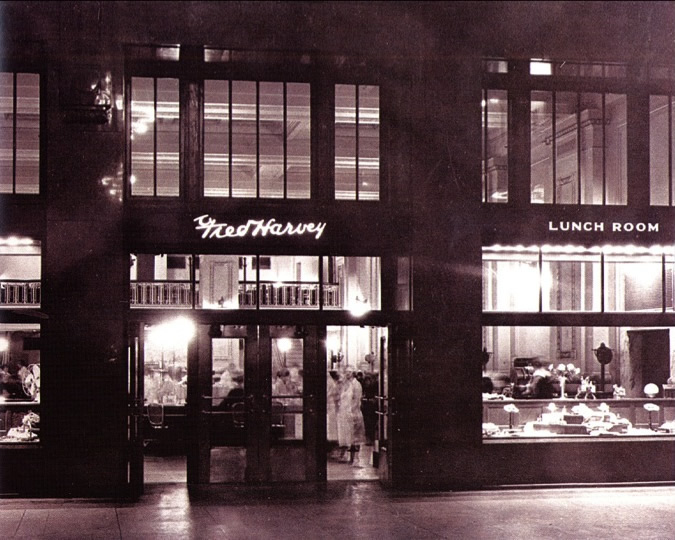
Back in the 1950s, my friends and I would go down to the Union Station to wander around through the shops, watch the people coming in from the trains and eat lunch. Since we were black, we could not eat at Fred Harvey’s.
We ate way in the very back of the station at the lunch counter with the stools where the railway employees ate.
In the 1960s when the Public Accommodation Law was passed, we started eating at Fred Harvey’s. All of the waitresses in all of the Fred Harvey’s throughout the country were middle aged white women. Most of them were skilled enough at their jobs to graciously take in stride having to wait on Negroes (that’s what we were called then).
I recall one waitress who brought me a little silver gravy boat of gravy when I asked for extra gravy for my hot beef sandwich. I tipped her generously.
But on one or two of the waitresses simply could not conceal their dislike and resentment at having to serve us. I never reacted to their discourtesy. I pretended not to be aware. But when I departed, I gave vent to my true feelings. I left a penny tip on the table!
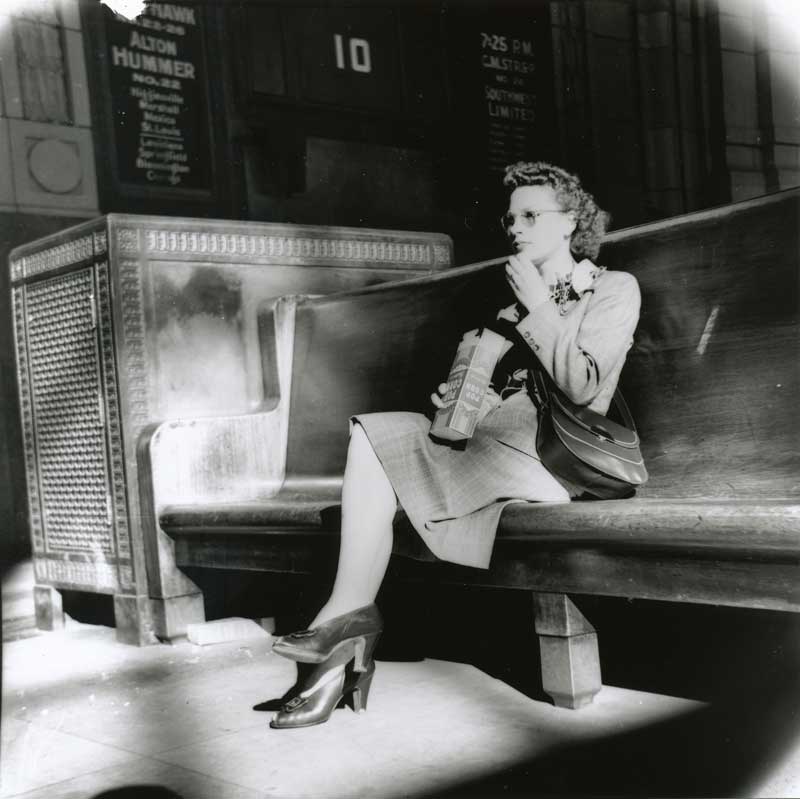
My mother, Bernice Rick, sits in the North waiting room of Union Station on May 25, 1947. This photo was taken by my father Robert Rick with their first new (Argo Flex) camera. If you look over her right shoulder you can see some of the trains listed that used Gate #10. They met at a USO dance while Dad was stationed at Scottfield near St. Louis.
Mom grew up on a farm near the airfield in Illinois. Dad was a native of Kansas City. They married in 1944 and came back to K.C. after Dad was discharged in 1946. Dad worked his first job after the war at Union Station (1946-48) for Western Weighing Bureau on the third floor. He later went to work for Union Pacific, in the Central West Bottoms, but missed the hustle and bustle of Union Station.
Mom and Dad both enjoyed going to the station for their enjoyment. One of these many outings were captured by their new camera. Mom also would use Union Station for her trips back to visit her family in Illinois. When my brother and I came along, we would accompany her on these trips on my Dad’s rail passes.
I still remember all of us hurrying along the platform beside our train — which seemed a mile long — as the conductor’s song, “All Aboard” rang out!
Clara Lloyd Many memories of that station.
I took the train from KC to Fort Worth, Tx and TCU for four years, and to the University of Wisconsin for one year.
We met my husband to be coming in from Chicago by train just before our wedding.
Later Bill’s office was in Crown Center, so he saw the station every day.
An important landmark in our lives. Thanks for sharing.
Union Station Kansas City likes this.
I have so many memories of Union Station it’s hard to single one out. My father worked for ti-ie kansas city terminal from 1926 to 1965, as a redcap, assistant station master and on the public address system.
I loved to go to work with him. He worked 3 p.m. to 12 a.m. We would have dinner in the employees’ lunch room way in the back of the station. All the redcaps would be talking about the famous people they may have helped that night. I saw several myself. Roy Rogers, Burt Lancaster, and Constance Bennet. I saw Kate Smith sing for the troops during World War II.
I passed my evenings by reading comics and movie magazines borrowed from the stands that were in the middle of the lobby, also there was the Fred Harvey toy store full of toys unique to that store.
There was also a soda fountain with all kinds of sundries needed for travel. We would have ice cream sodas at the fountain. The ladies restroom was a huge waiting room with couches for naps and rocking chairs for calming tired children between train connections. Sometimes we would exchange addresses for pen pals.
One night, my dad came home with a large box for me. He said Cecil B. DeMille bought it for me.
I couldn’t believe it. It was the beautiful baby doll I had been wanting for weeks at the Fred Harvey toy shop.
My dad had carried Mr. DeMille’s luggage and had been tipped $50. My dad used it to buy the doll. I told everyone Mr. DeMille bought it for me. It was my favorite for years.
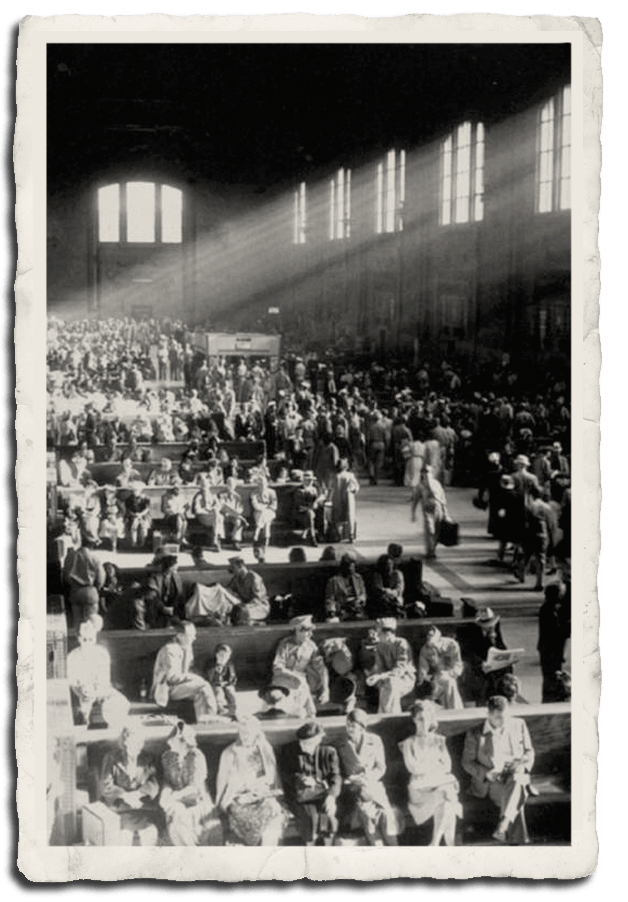
In the eyes of a child, everything is big. This was especially true of the Union Station. It seemed to be the biggest building in Kansas City. Sometimes I was allowed to wander around the stations cavemous interior within sight of my parents.
I would stop and stare up at the great chandeliers. I often thought, “Who is the person that dusts the chandeliers?”
It seemed to me it would be a dangerous job to be up so high dusting the chandeliers.
My wanderings always finished in the Waiting Room. I would sit there and watch the smartly-dressed travelers pass by, watch the minute hand move on the big clock, or hear an important sounding voice coming from a loudspeaker naming exotic places such as Chicago, Flagstaff or New Orleans and trains with equally exotic names like Super Chief, Portland Rose, or Southern Belle.
If it was wintertime and I was cold I would stand with my back next to one of the big steam radiators and be warm in no time. If was sleepy I could lay down on one of the big wooden benches and take a nap just like the soldiers and sailors.
The memory of seeing the servicemen and women in the Waiting Room recalls something my maternal grandfather always said whenever he was in a crowded, busy public place: “Yep … this is busier than Union Station during wartime!” I heard an estimated 4 million servicemen and women passed through Union Station during World War II. The Waiting Room was probably pretty busy.
I am glad to see Union Station restored. I will be interested to see if the Waiting Room is still as big as I remember. Who knows, I might also actually see someone dusting the chandeliers.
Bill started his 36 year employment at Union Station on February 13, 1942. Previously he had worked at the Jones Store in downtown Kansas City where he met Jerry Burke, a local travel agent with an office in the store. Bill often made deliveries for Jerry in his free time. One day, Jerry told Bill about an opening at Union Station for a job in the ticket office. Bill interviewed with J.W. Dunn and took the job!
After three days of training — no pay! — he began as a telephone clerk before moving to the job of ticket agent, often working the night shift and with only one day off each week. Ticket agents were responsible for calculating train fares, based on mileage. There were several fare types … standard, clergy, first class, “remains” unescorted, “remains” escorted, and round trip. Tickets had to be purchased in cash … no checks!
There was a strict dress code … white shirt and tie. On May 15, 1942 Bill’s son Bill, Jr. was born at nearby St. Mary’s hospital. Dad showed up at work in a blue shirt and was sent to a local shop to purchase a WHITE shirt!
During the years of very busy train travel, agents frequently had to work overtime and needed a place to rest before their next shift. On the 6th floor of the station was a dormitory operated by Pullman Conductors.
One advantage of working at the station was the availability of good food at the Harvey House. In the early years the ticket sellers had their own table and the average cost for lunch was 75 cents! Bill was a friend of Joe Maciel “maître d” at The Westport Room and secured the recipes for two favorites …”Picatta” and “Chicken Maciel.” They remain family favorites.
Bill worked the station from the peak of rail travel during World War II, to its decline in the early days of Amtrak. He knew President Truman, celebrated New Year’s on the top of the circular ticket office, raised a fine family and traveled — by train — throughout the United States.
After 36 years at the Station, he retired at 8:00 AM, September 6, 1978, after completing the night shift.
At the time of this writing, October 6, 2014, Bill just had his 96th birthday and plans to attend the celebration on October 31.
Norma Carey: In the early 1960’s my sister and I would ride the train from Appleton, Wisconsin to a little bitty dot on the map called Neal Springs near Horatio, Arkansas to spend summers with our grandmother. We took the Kansas City Southern and had a stopover in Kansas City.
We had a great adventure exploring the huge station!
Train travel was so fabulous to two young girls! We had a berth in the sleeping car, ate in the diner, and most exciting of all was going from car to car in that big, loud open space! Great memories! Magnificent station!!
Union Station Kansas City likes this.
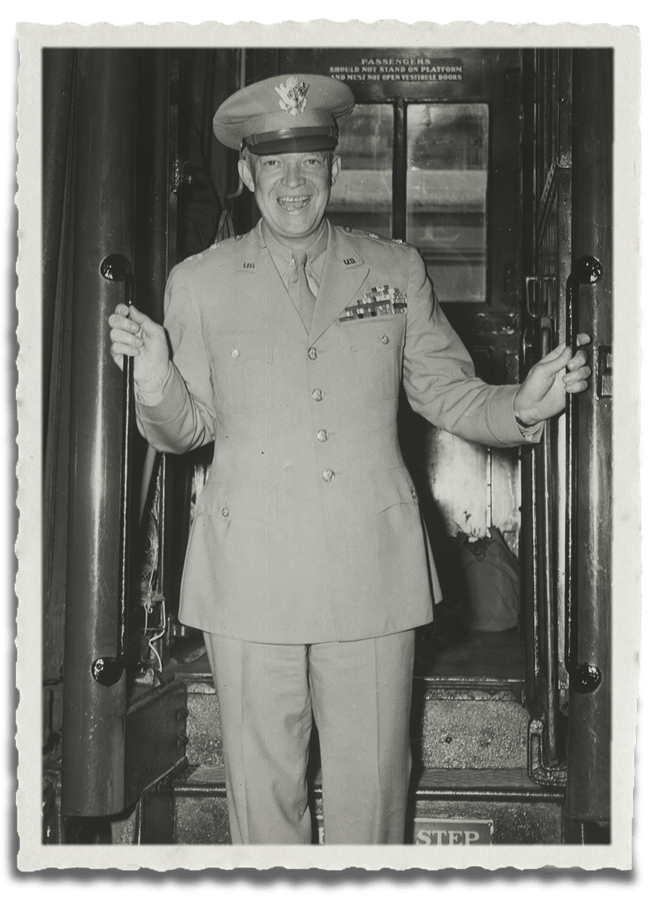
From the Dwight D. Eisenhower Library in Abilene, Kansas.
June 21, 1945 — arrived in K.C., MO. By train, enroute to Abilene, Ks. MDE, DDE, and family by special train.
June 23, 1945 — return to K.C. by train from Abilene. MDE and DDE boarded private car for trip to Wash., D.C. (Arr. DC on June 25).
Sept. 12, 1946 — trip from Washington, DC (left on Sept. 11) to Abilene, passes through K.C. on Sept. 12.
July 15, 1950 — New York to Califomia trip, stop in K.C. on July 15; DDE’s train leaves K.C at 9:30 pm (Santa Fe Railroad.).
Sept. 17, 1950 — trip film Denver, Colorado to New York on Wabash Car #400. I assume this train passed through K.C. on Sept. 17 or 18.
Dec. 19, 1950 — New York to Denver trip and return. Dec. 19 Wabash train through K.C. at 9 to 9:30 pm. Dec. 26 — train leaves Denver for return to NYC.
June 4, 1952 — DDE took train from K.C. to Abilene (appointment books specify that he flew in to K.C., Ks. Airport but don’t specify at what depot he boarded the train for Abilene).
Sept. 19, 1952 — Campaign Train, arrived at Union Station, K.C., Mo. at 3:45 pm and left K.C at 7:20 am on Sept. 20 (Missouri Pacific Railroad).
1953-61 — Presidential Years. Eisenhower tended to fly everywhere and did not take the train very often.
May 1, 1962 — trip to Abilene (not sure of mode of travel)
July 1, 1963 — trip to Denver, arrived at K.C, Mo. at 8:30 pm and left K.C. at 10:50 pm (Santa Fe Railroad).
Nov. 28 to Dec. 2, 1967 — trip to Abilene and on to California, traveled by train through K.C.
This is definitely not a complete list of all occasions when DDE passed through K.C. by train. We just don’t have documentary evidence on the period from 1914 to 1945.
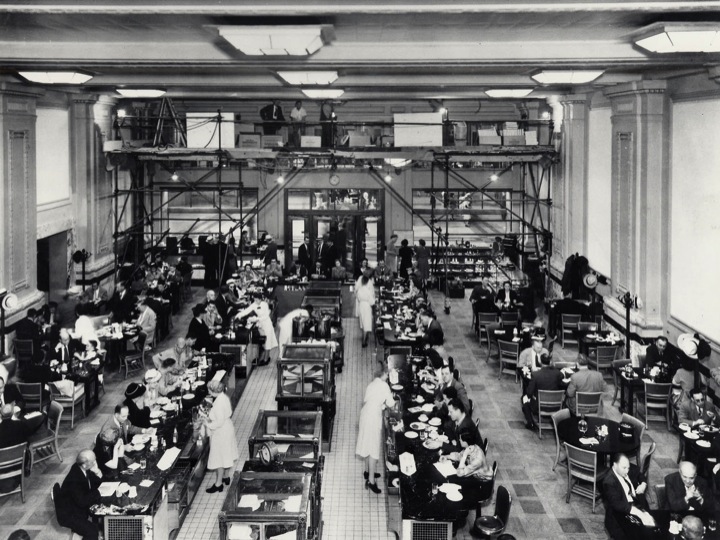
In 1952, I went to work as a Red Cap in Union Station. In 1960, I began working in the ticket office. In the spring of 1956, someone told me there was a new waitress working at Fred Harvey. I went over there and sat at the horseshoe counter and ordered bread pudding (it was the best I have ever eaten!). The new waitress waited on me and, when she got off work, I met her in the lobby and walked her to the bus stop. I did this almost every night until we got married on November 30, 1957. My wife, Rita, worked until February 1958 when we started our family.
We have 4 sons and ll grandchildren. Our life started at the Union Station, and we have a lot of good memories. I worked in the ticket office at Union Station until my retirement in 1989.
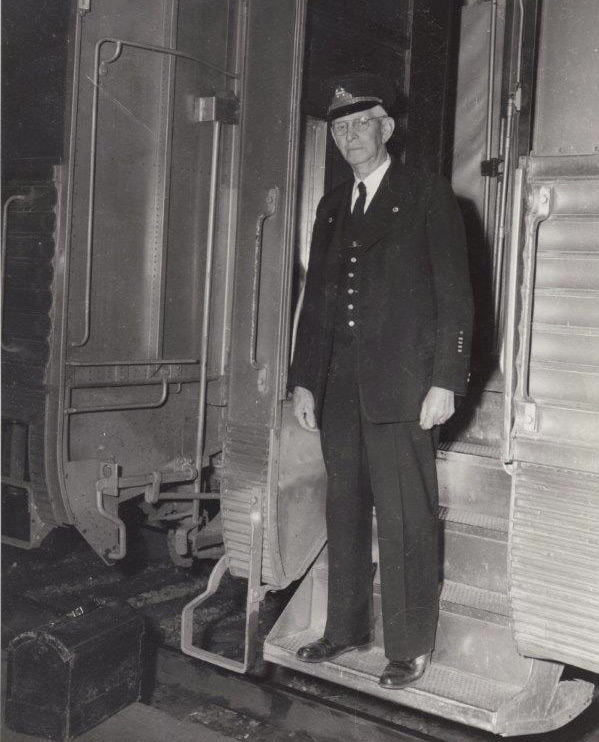
For the railroad industry, Union Station meant booming business and celebrated careers; R.P. John enjoyed 50 years on the railroad.
John was the conductor for the Santa Fe Chief. His careers began in 1905 when he was looking for work, and his passion for the railroad would inspire a legacy. Of all seven children, he had four sons that worked for the railroad, two who became conductors for Santa Fe, and one daughter who was married to a Santa Fe break man.
At 76, R.P. John conducted his last ride from Newton, KS and removed his conductor’s hat from his snow-white head, and ended a celebrated career that would continue through his children’s work.
For John and his family the railroad represented opportunity and tradition, as they remained employed by Santa Fe/BNSF for 100 consecutive years.
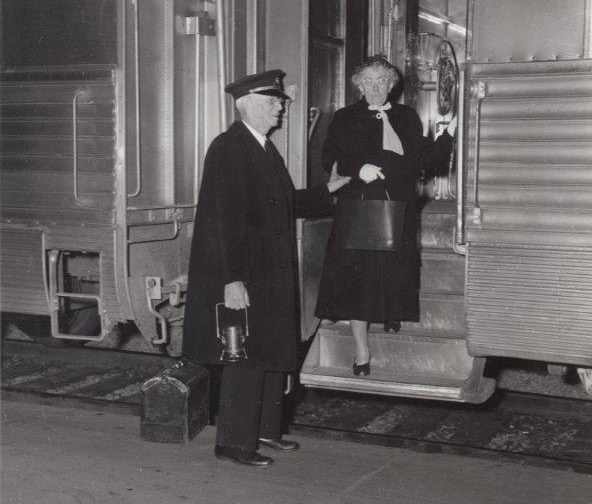
R.P John on his last ride from Newton, KS
The Union Station holds very special childhood memories for me through the mid 1950’s-1960’s.
My dad, Dr. Graham Owens, had his office there so we spent many Saturdays “going to the office” with dad. The BEST memories though were having train tickets out west. We would often travel either to Pasadena, CA where my mother grew up….or to Spokane, WA to visit my dad’s sister, Jean Owens Brown. Either way, getting on that evening train at the beautiful bustling Union Station was always exciting.
And who wouldn’t look forward to two nights in a Pullman, with a dome car, fine dining on the Union Pacific while riding through the beautiful Rocky Mountains?
Thank you for celebrating the history of a wonderful building, full of history and so important to Kansas City!!
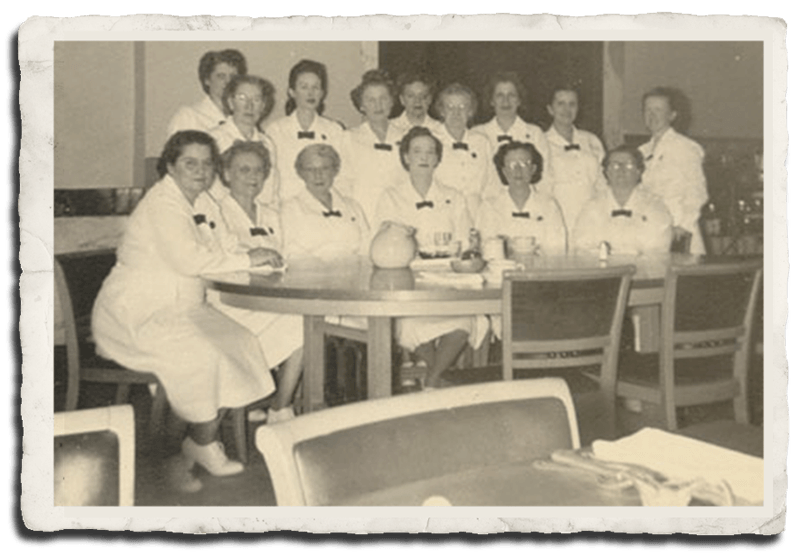
Union Station has remained a dining destination for everyone in Kansas City. Dee Rathbun arrived in Kansas City for a US Army physical in 1960 after being selected by the Draft Board in Lincoln Kansas. While staying at the Armed Forces Building located near Union Station he enjoyed meals from Fred Harvey’s.
“For a Kansas Farm Boy 200 miles west of Kansas City this was a very big and memorable deal,” Rathbun said.
Rathbun remembers walking over two-by-two with the other 100 men who were there for their military physicals.
Today, Rathbun enjoys volunteering at Union Station.
Mary Maxwell’s life in Kansas City began at Union Station. In January of 1955, Mary and her family arrived at Union Station from San Antonio, Texas. Maxwell recalled the fear and thrill of feeling the snow for the first time upon their arrival.
Later that year, Mary met her older brother for the first time at Union Station. He and his wife arrived by train and the Maxwell’s met them in the Great Hall. Mary remembers hiding under her mother’s skirt after seeing her “larger than life brother” who towered over her at 6’4”. Even today, she and her brother like to revisit memories by going to the station.
Maxwell also remembers Union Station at Christmas time as a magical experience. She and her family took the train to Mississippi from the Station to visit her grandmother. The carts of packages and bustle of the travelers enchanted her, as they would prepare for their holiday celebrations. Today, Maxwell shared this magic with her grandson and took him to see Santa Claus and the model train exhibit. Union Station remains a constant presence in her life in Kansas City and she looks forward to many more memories.